
I am a Ph.D. candidate in Electrical and Computer Engineering at New York University, working within the EnSuRe Research Group under the advisement of Siddharth Garg and Farshad Khorrami. My research is dedicated to advancing the visual understanding and reasoning of Multimodal Large Language Models (MLLMs) and Foundation Models.
During my PhD, I interned at Adobe (summer 2025), where I built evaluation frameworks for visually-guided image editing, and at Apple (summer 2026), where I worked on video temporal grounding for an internal visual search product.
I will be graduating in December 2026 and am actively seeking full-time research roles. My work and interests focus on advancing foundation models, multimodal reasoning, and visual understanding.
Research
My research is at the intersection of computer vision and multimodal large language models, with a focus on how these models perceive, align, and reason about visual content. My earlier work spans perceptual similarity metrics and visual alignment in multimodal LLMs, where I studied how to make vision-language systems more robust and better aligned with human perception. Building on this foundation, I have increasingly turned to the temporal dimension of visual understanding.
In Chain-of-Frames (CVPR 2026), I introduced a frame-aware reasoning approach for video understanding in MLLMs that produces explicit temporal grounding traces, leveraging synthetic data to teach models to anchor their reasoning in specific frames rather than treating videos as undifferentiated visual context. I have since extended this line of work from single-video to multi-video settings.
In my latest project, SYNCR, I introduce a simulator-grounded framework that uses the same task generators to both diagnose cross-video reasoning failures and test whether targeted supervision can fix them. Built on Habitat, Kubric, and CLEVRER, it derives answers from environment state across eight tasks spanning temporal alignment, spatial tracking, comparative reasoning, and holistic synthesis.
News
- Oct 2026follow-up work to SYNCR released on learning cross-video reasoning from simulation.
- Sep 2026SYNCR was accepted to a NeurIPS 2026 Workshop.
- Aug 2026Wrapped up my internship at Apple, where I worked on video temporal grounding.
- Jun 2026Attended CVPR 2026 to present my Chain-of-Frames paper.
- May 2026Joined Apple as an Applied Research Scientist Intern for summer 2026.
- May 2026SYNCR released on arXiv, a controlled synthetic benchmark for cross-video reasoning.
- Feb 2026Chain-of-Frames was accepted to CVPR 2026.
- Dec 2025Attended NeurIPS 2025 to present SpotEdit and Chain-of-Frames papers.
- Sep 2025SpotEdit accepted to NeurIPS 2025 Workshop, with benchmark and code released on GitHub.
- Jun 2025Chain-of-Frames released on arXiv, with code and models on GitHub.
- May 2025Joined Adobe as a Research Intern, advancing research on unified multimodal models.
- May 2025EMMA accepted to TMLR 2025.
- Apr 2025UniSim accepted to CVPR Workshop 2025.
- Jun 2024Attended CVPR 2024.
- Jan 2024LipSim accepted to ICLR 2024.
- Jun 2023R-LPIPS accepted to ICML Workshop 2023.
- Jan 2023Started my Ph.D. at NYU.
Publications
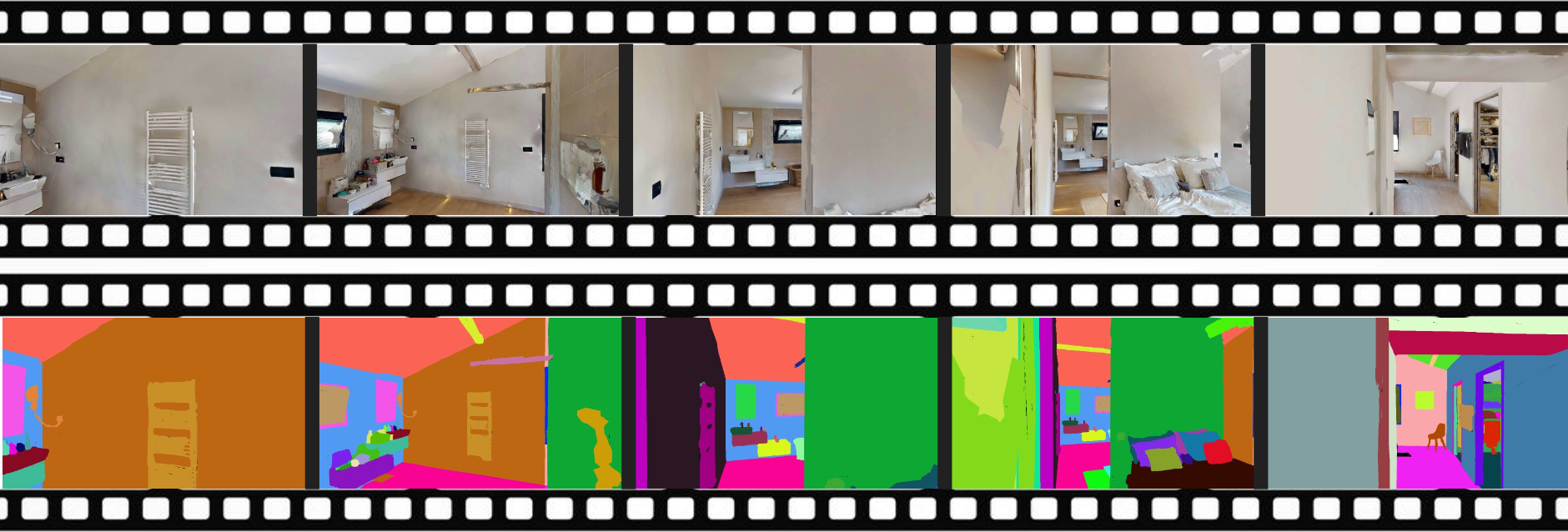
We extend SYNCR into a simulator-grounded framework for both diagnosing and learning cross-video reasoning, with 4,000 evaluation and 15,960 training questions spanning eight tasks. Evaluating 22 MLLMs reveals persistent failures in physical comparison and scene integration, while fine-tuning on SYNCR nearly doubles accuracy and transfers to temporal ordering on real footage.
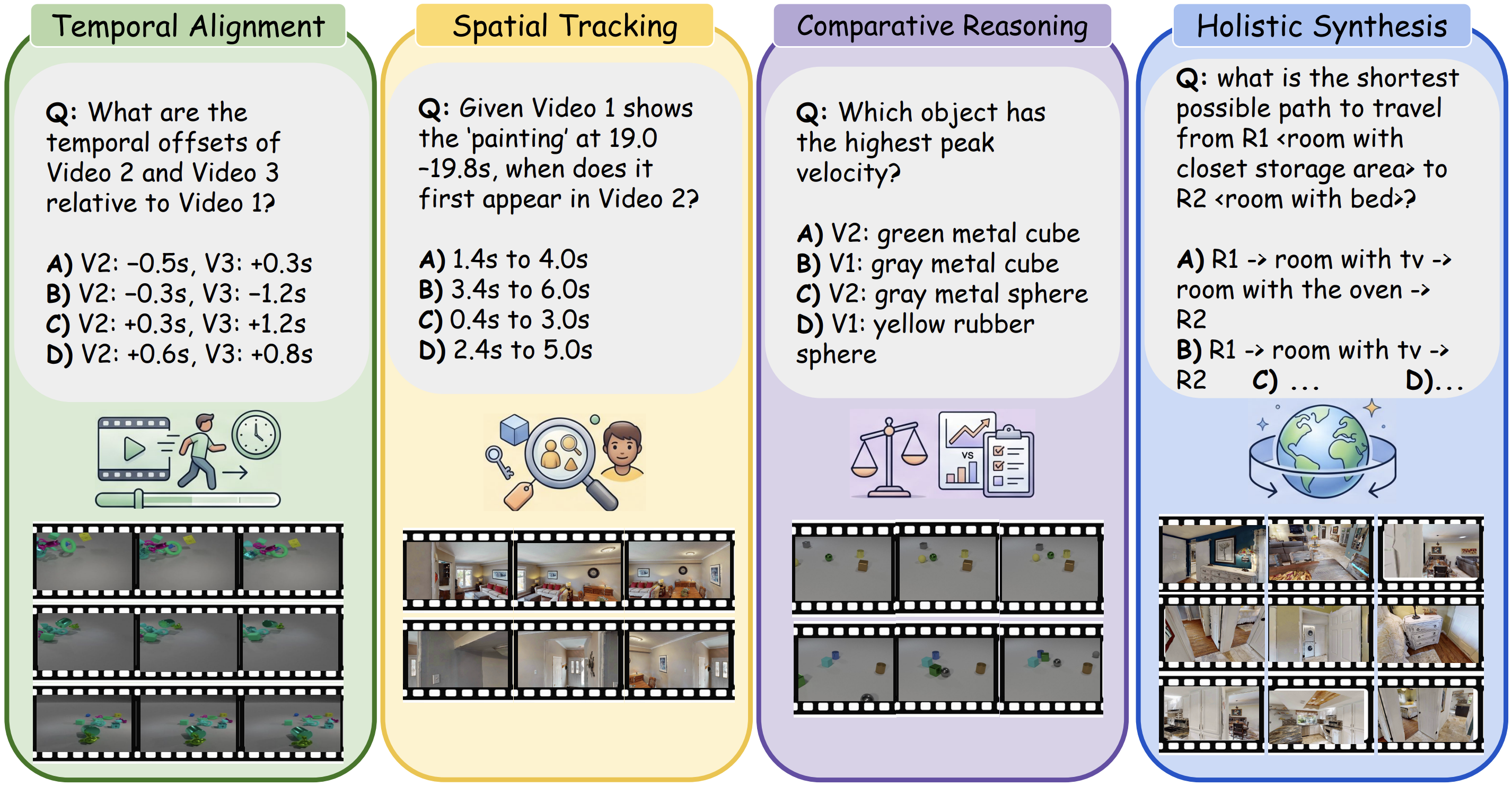
We introduce SYNCR, a controlled synthetic benchmark for cross-video reasoning with programmatically verified grounding. Built using Habitat, Kubric, and CLEVRER, it contains 8,163 multi-video QA pairs evaluating MLLMs across four diagnostic pillars, revealing a substantial gap between current models and human performance.
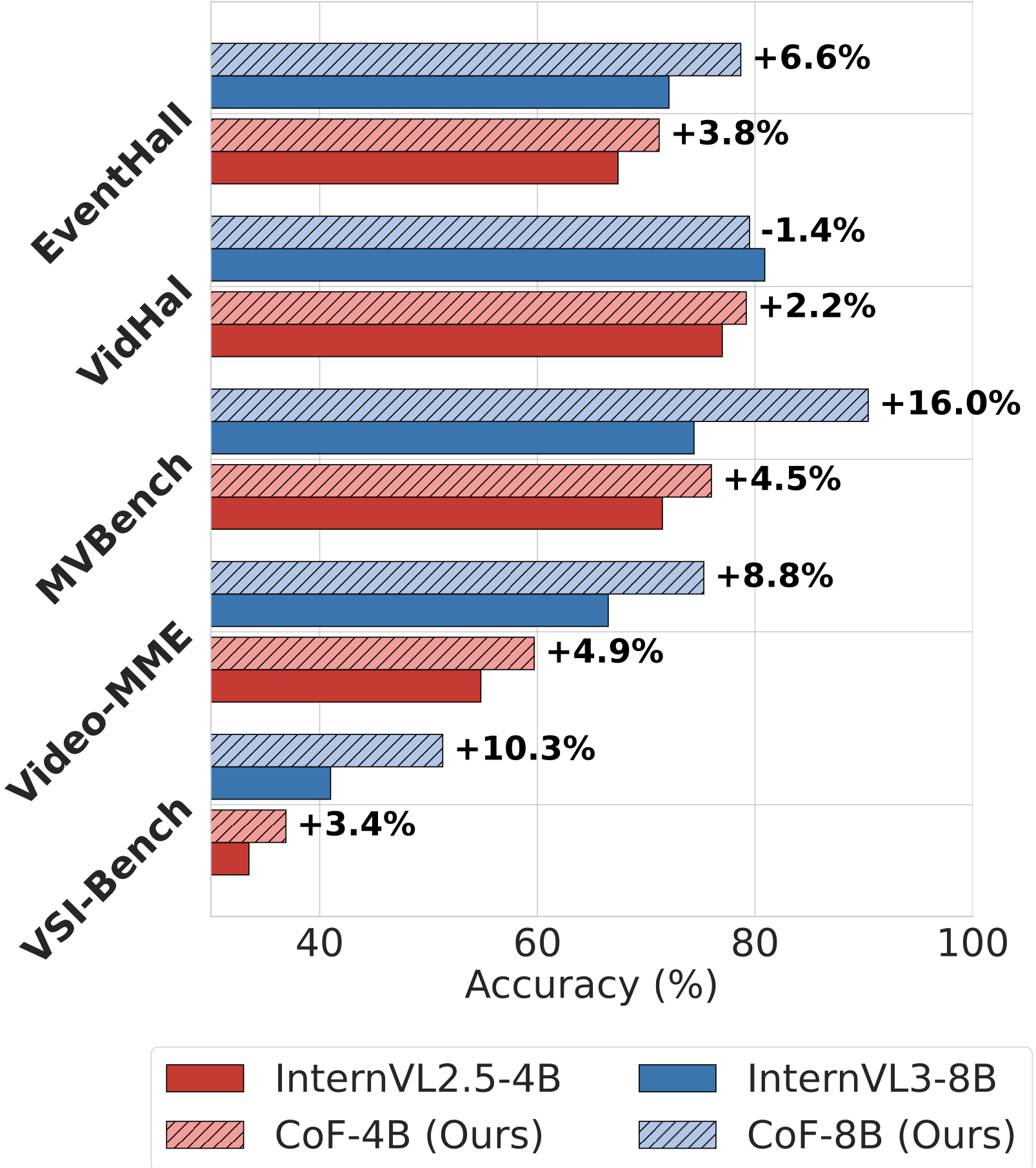
We propose chain-of-frames (CoF) to obtain video LLMs whose reasoning steps are grounded in, and explicitly refer to, the relevant frames. Fine-tuned on a large dataset of synthetic and natural video reasoning traces, our models outperform baselines without requiring complex inference pipelines.
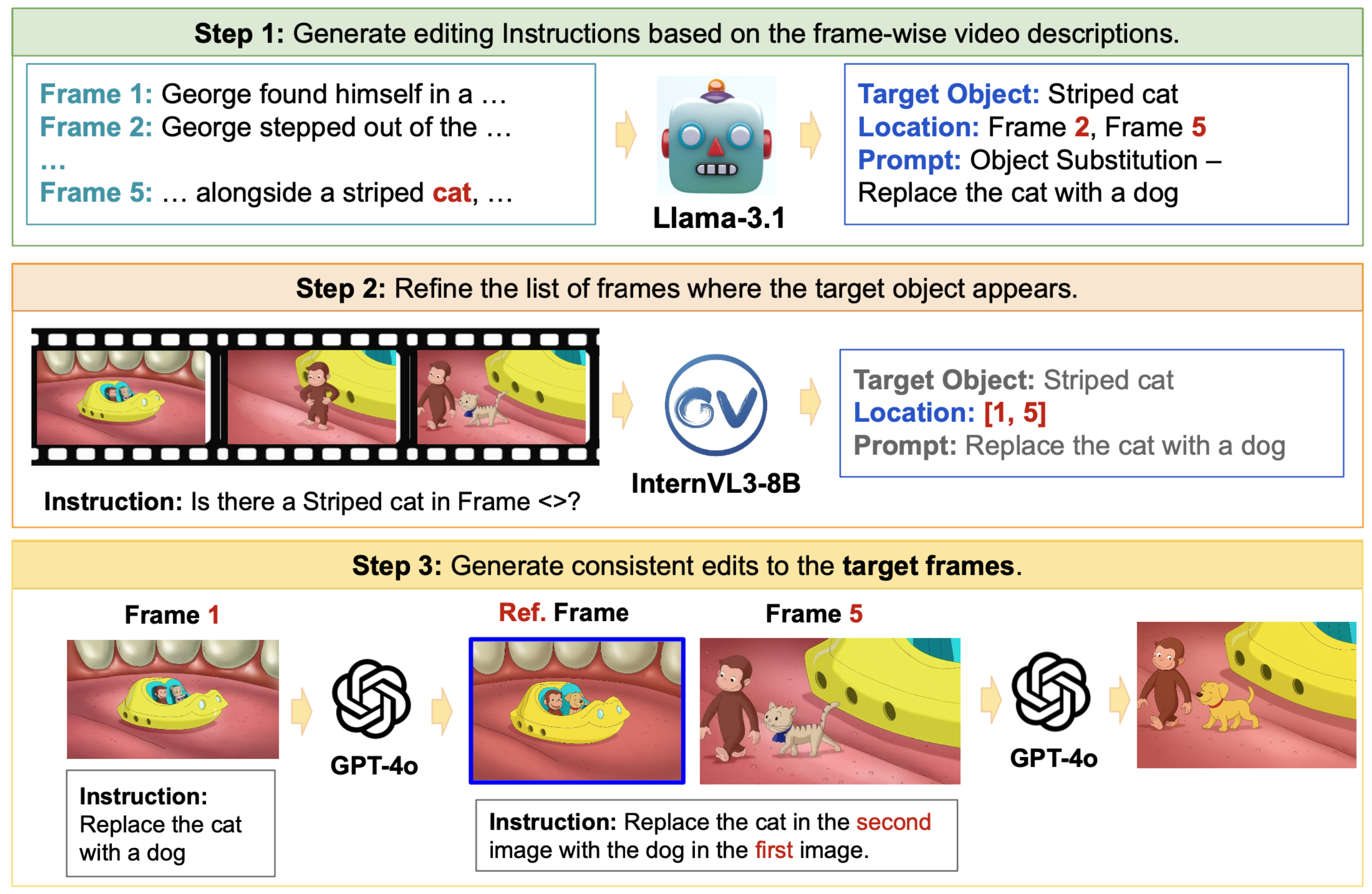
SpotEdit is a comprehensive benchmark designed to systematically assess visually-guided image editing methods. It highlights a critical hallucination component, uncovering how leading models like GPT-4o erroneously perform edits by hallucinating visual cues.
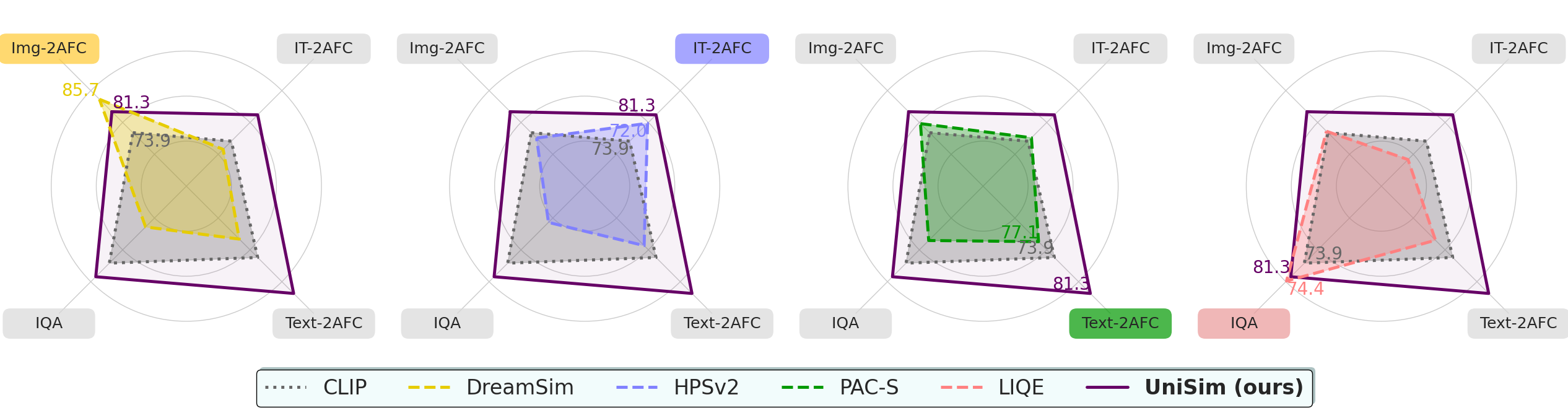
UniSim-Bench tracks the progress of perceptual similarity metrics across uni- and multimodal tasks. We propose UniSim, a set of multi-task models that lay the groundwork for understanding general-purpose perceptual metrics beyond narrow applications.
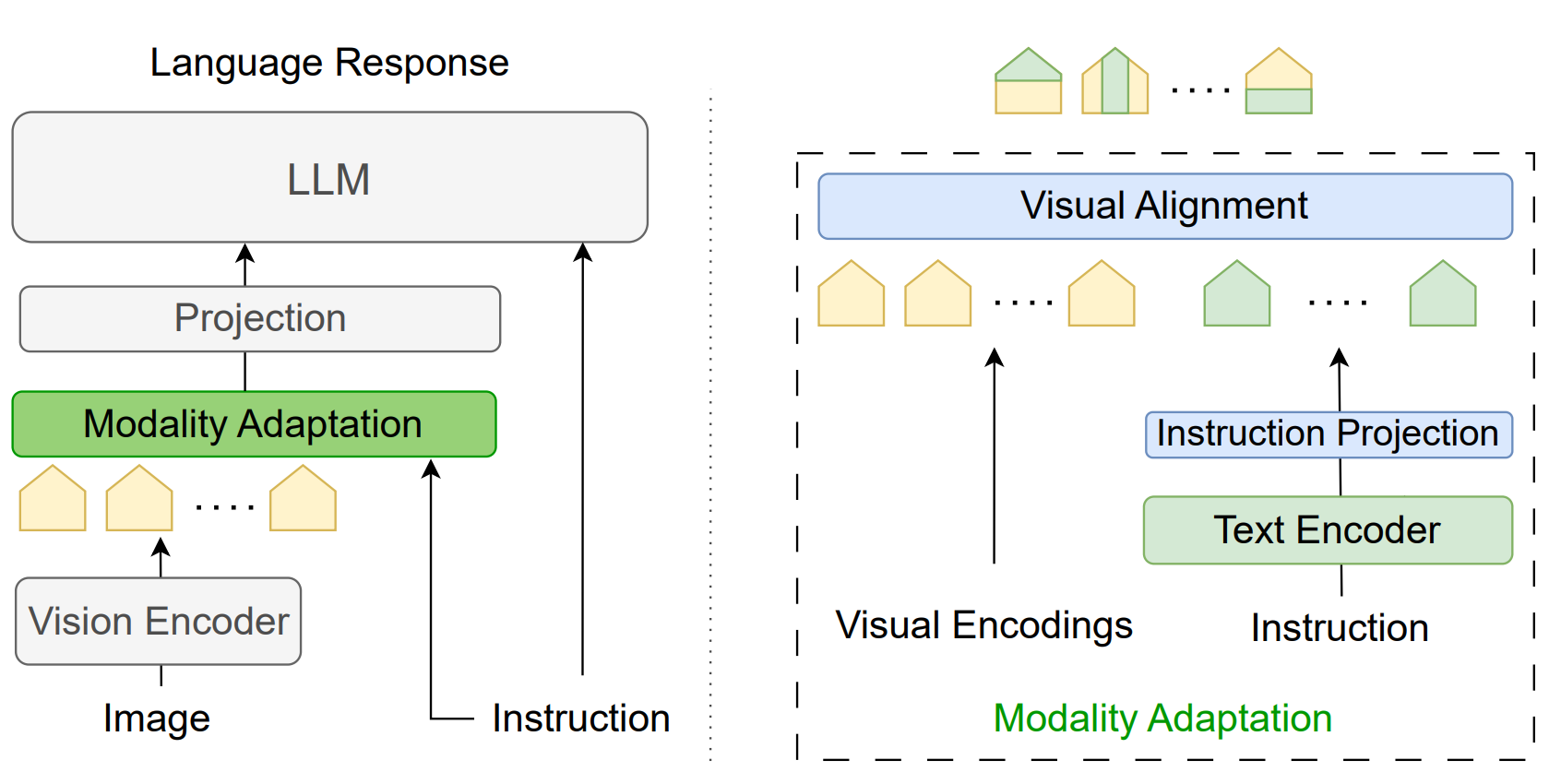
EMMA (Efficient Multi-Modal Adaptation) is a lightweight module designed to fuse visual and textual encodings with minimal added parameters. It generates instruction-aware visual representations, boosting performance and reducing hallucinations.

We demonstrate the vulnerability of SOTA perceptual similarity metrics to adversarial attacks. We propose LipSim, trained with 1-Lipschitz neural networks, to provide a robust metric with provable guarantees.
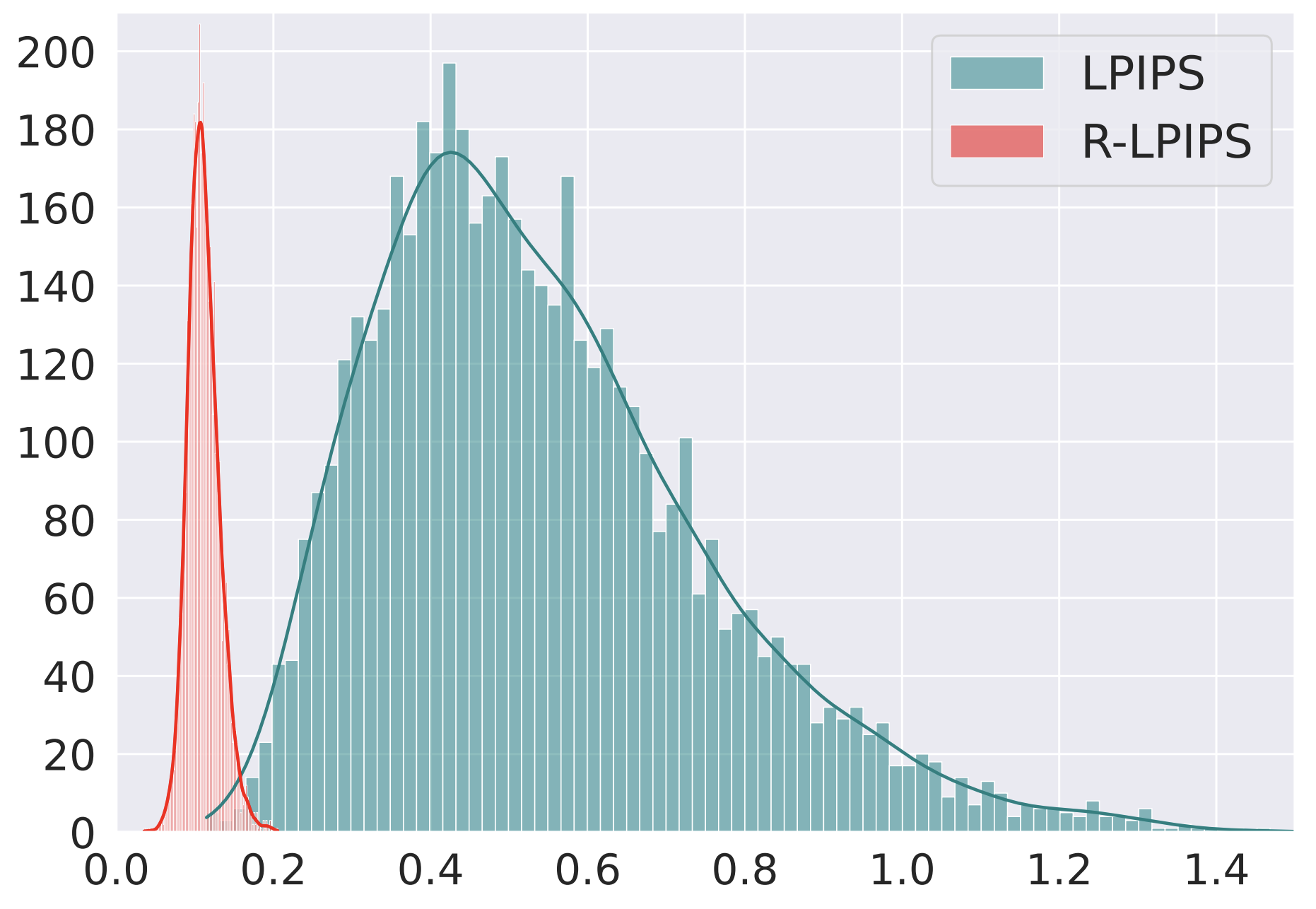
We show LPIPS is sensitive to adversarial perturbation and propose R-LPIPS via Adversarial Training. R-LPIPS leverages adversarially trained deep features to demonstrate robustness compared to the standard metric.